Martin (Dtsch), page 379 - 380 & 389
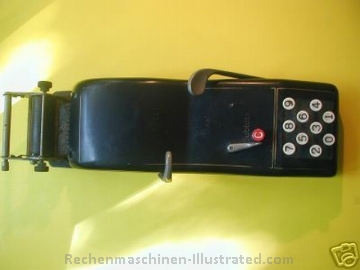
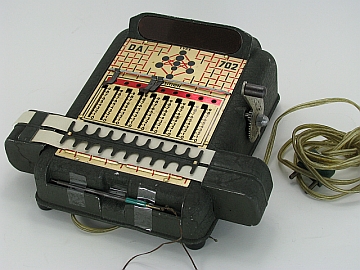
"In both size and shape, this machine closely resembles the Scribola, illustrated in figure 286 (32 X 9 X 7 cm, 2.5 kg), but instead of a chain drive it has ten adding keys. It prints both individual items and totals on 58-mm wide paper. There is a lever, attached on the right, that is used to add and print the items that have been entered. The totals are printed when the left lever is moved-it is not necessary to enter them again. It has a single-color ribbon.
Capacity: eleven-place setup mechanism, twelve-place result mechanism.
The price of the machine is 400 marks. Manufacturer: Amigo Addiermaschinen Gesellschaft, 11 Müillerstrasse, Stuttgart-Gaisburg."
| principle | chain adder |
|
|
| capacity | 11 (w/o cr) x x 12 |
||
| input | 10 keyboard | ||
| prod. years | 1925 - ca. 1928 | ||
| mach. built | few | ||
| features |
1 species, printing |
||
| dimensions | 11 x 36 x 10 cm | ||
| weight | 4 kg | ||
| known s/n | 157 - 377 | ||
| for bigger and more pictures, click on the picture | |||
| source: R.Meier |
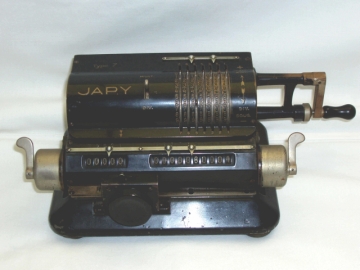
manufacturer: Japy Frères, Beaucourt, France
Type 7
| principle | pin wheel |
|
|
| capacity | 7 (w/o cr) x 5 (w tc) x 10 |
||
| input | cursors, rotating | ||
| prod. years | 1925 | ||
| mach. built | |||
| features |
|
||
| dimensions | 31 x 17 x 12.5 cm | ||
| weight | 5 kg | ||
| known s/n | 60.001 | ||
| for bigger and more pictures, click on the picture | |||
| source: HJ.Denker |
Martin (Dtsch), page 380
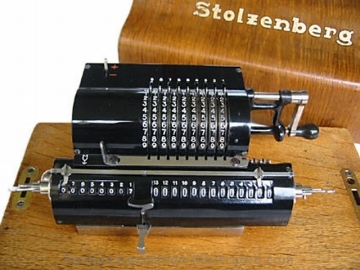
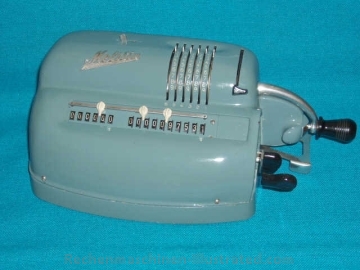
"This is a miniature pinwheel machine with continuous tens-carry in the revolution counter. The shift from addition to subtraction occurs automatically when the crank is turned in the opposite direction. Manufacturer: Mercedes Bureaumaschinenwerke, Charlottenburg 2, Berliner Strasse 153."
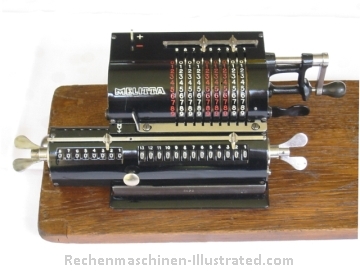
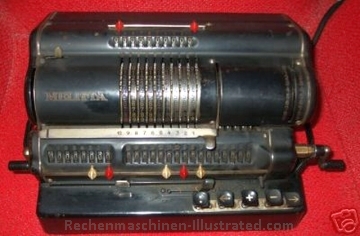
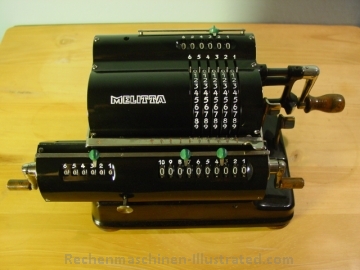
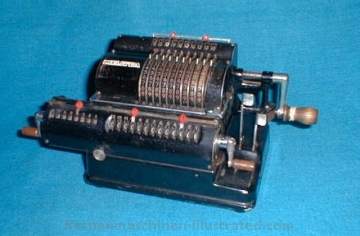
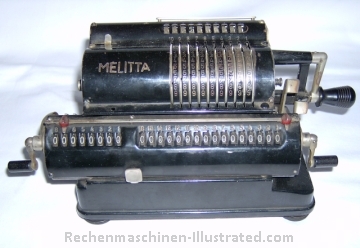
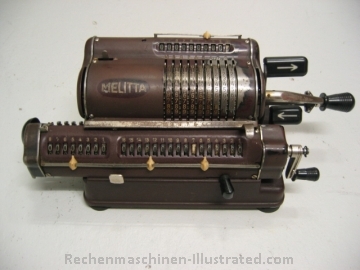
Melitta machines were manufactured by the Mercedes Büromaschinen-Werke, Zella-Mehlis, from 1924 on.
In 1926/27 production was turned over to the Walther Werke, also Zella-Mehlis. Identical machines were sold as Melitta and Walther by both companies.
Melitta machines were also marketed by other companies under their brand, like Stolzenberg.
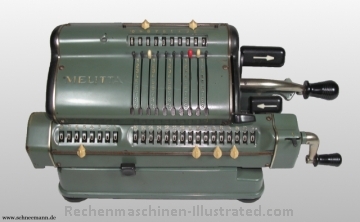
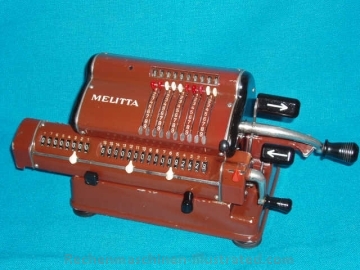
After World-War II, Melitta models were manufactured and sold independent from Walther (see below).
Literature and links:
Reese,M.: Neue Blicke auf alte Maschinen (2002) , pages 87 ff. (IFHB)
| principle | pinwheel |
|
|
| capacity | 9 (w/o cr) x 8 (w/o tc) x 13 |
||
| input | cursors, rotating | ||
| prod. years | 1924 | ||
| mach. built | |||
| features |
spring-loaded carriage |
||
| dimensions | |||
| weight | |||
| known s/n | 157 | ||
| for bigger and more pictures, click on the picture | |||
| source: D.Bölter |
restoration of an experimental model
Literature and links:
D.Bölter: Melitta T & documentation
Museum in der Beschußanstalt Zella-Mehlis
| principle | pinwheel |
|
|
| capacity | 9 (w/o cr) x 8 (w/o tc) x 13 |
||
| input | full keyboard | ||
| prod. years | 1924 | ||
| mach. built | 1 | ||
| features | |||
| dimensions | |||
| weight | |||
| known s/n | 12 | ||
| for bigger and more pictures, click on the picture |
source: D.Bölter
| principle | pinwheel |
|
|
| capacity | 9 (w/o cr) x 8 (w/o tc) x 13 |
||
| input | cursors, rotating | ||
| prod. years | 1925 - ? | ||
| mach. built | |||
| features |
spring-loaded carriage identical to Walther 1 |
||
| dimensions | 29 x 13 x 10 cm | ||
| weight | 4.5 kg | ||
| known s/n | 36, 1.315, 1.497, 2.432, 2.703 | ||
| for bigger and more pictures, click on the picture |
source: D.Bölter
manufacturer: Fortuna Werk, Suhl/Thüringen, DDR
| principle | pinwheel |
|
|
| capacity | 10 (w cr) x 8 (w tc) x 16 |
||
| input | cursors, rotating | ||
| prod. years | |||
| mach. built | |||
| features |
electric identical to Walther EMKD |
||
| dimensions | |||
| weight | |||
| known s/n | 100,255 | ||
| for bigger and more pictures, click on the picture |
source: R.Geisler
| principle | pinwheel |
|
|
| capacity | 6 x 5 x 10 |
||
| input | cursors, rotating | ||
| production years | ca. 1933 - 1938 | ||
| machines built | |||
| features | |||
| identical to Walther RK | |||
| known s/n | 11.661 | ||
| for bigger and more pictures, click on the picture |
source: S.Wolff
| principle | pinwheel |
|
|
| capacity | 10 x 8 x 13 |
||
| input | cursors, rotating | ||
| production years | ca. 1929 - 1938 | ||
| machines built | |||
| features | |||
| identical to Walther RMK | |||
| known s/n | 50.383 | ||
| for bigger and more pictures, click on the picture |
source: HJ.Denker
manufacturer: Fortuna Werk, Suhl/Thüringen, DDR
| principle | pinwheel |
|
|
| capacity | 10 (w cr) x 8 (w tc) x 16 |
||
| input | cursors, rotating | ||
| prod. years | ca. 1950 | ||
| mach. built | |||
| features |
identical to Walther RMKZ |
||
| dimensions | 29 x 14 x 14 cm | ||
| weight | 3 kg | ||
| known s/n | 64,037 | ||
| for bigger and more pictures, click on the picture |
source: H.Ansorge
manufacturer: Fortuna Werk, Suhl/Thüringen, DDR
| principle | pinwheel |
|
|
| capacity | 10 (w cr) x 8 (w tc) x 16 |
||
| input | cursors, rotating | ||
| prod. years | ca. 1950 | ||
| mach. built | |||
| features |
spring-loaded carriage |
||
| dimensions | 30 x 12 x 13 cm | ||
| weight | 4 kg | ||
| known s/n | 70,882 , 73,601 | ||
| for bigger and more pictures, click on the picture |
source: R.Fedeli
manufacturer: VEB Ernst Thälmann Werk, Suhl/Thüringen, DDR
| principle | pinwheel |
|
|
| capacity | 10 (w cr) x 8 (w tc) x 16 |
||
| input | cursors, non-rotating | ||
| prod. years | ca. 1955 - 1960 | ||
| mach. built | |||
| features |
spring-loaded carriage |
||
| dimensions | 33 x 14 x 16 cm | ||
| weight | 4.5 kg | ||
| known s/n | 126 050, 126 789 | ||
| for bigger and more pictures, click on the picture |
source: H.Schneemann
manufacturer: VEB Fortuna Werk, Suhl/Thüringen, DDR
| principle | pinwheel |
|
|
| capacity |
10 x 8 x 16 |
||
| input | cursors, non-rotating | ||
| production years | ca. 1955 - 1960 | ||
| machines built | |||
| features | spring-loaded carriage | ||
| back transfer | |||
| known s/n | 92.429, 107,503 | ||
| for bigger and more pictures, click on the picture |
source: HJ.Denker
| principle | pinwheel |
|
|
| capacity |
6 x 6 x 10 |
||
| input | cursors | ||
| production years | |||
| machines built | |||
| features | |||
| known s/n | |||
| for bigger and more pictures, click on the picture |
source: HJ.Denker
Martin (Dtsch), page 383
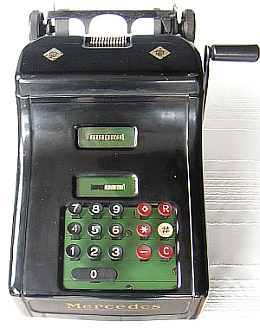
"This is a nine-key adding machine that also has eight tabulating keys. Again, this machine was never widely distributed and has not been manufactured for
a
number of years. Manufacturer: Mercedes Bureaumaschinenwerke, Zella-Mehlis"
| principle | tooth rack |
|
|
| capacity | 10 (w cr) x x 11 |
||
| input | 10 keyboard | ||
| prod. years | 1938 - 1973 | ||
| mach. built | |||
| features |
2 species, printing |
||
| dimensions | 19 x 35 x 19 cm | ||
| weight | 6.5 kg | ||
| known s/n | |||
| for bigger and more pictures, click on the picture | |||
| source: K.Badur |
Martin (Dtsch), page 385
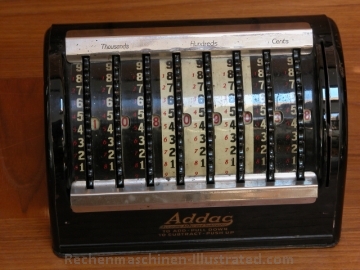
"Addac was a 8 digit adding- and subtraction-machine, manufactured by Addac Co., Grand Rapids, MI"
| principle | tooth segments |
|
|
| capacity | 8 and 9 | ||
| input | finger pads | ||
| production years | 1925 - 1927 | ||
| machines built | ???? | ||
| features | subtraction by complementary | ||
| digits | |||
| known s/n | 1.369, 3.133, 5.736 | ||
| for bigger and more pictures, click on the picture |
source: W.Szrek
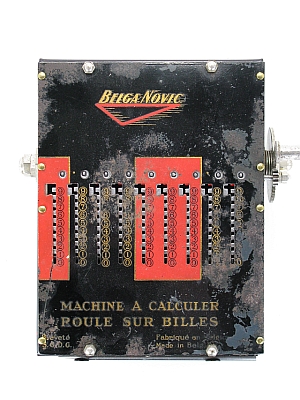
Manufacturer: Master, Bruxelles & Herstal-Liege (B)
simple slide adder
also marketed under Belga Novic
| principle | slide adder |
|
|
| capacity | 9 x x 9 |
||
| input | stylus | ||
| prod. years | from 1926 | ||
| mach. built | |||
| features | |||
| dimensions | 17 x 16 x 9 cm | ||
| weight | |||
| known s/n | |||
| price | |||
| for bigger and more pictures, click on the picture | |||
| source: van Noort |
| principle | slide adder |
|
|
| capacity | 9 x x 9 |
||
| input | stylus | ||
| prod. years | |||
| mach. built | |||
| features | direction of stylus is indicated by light | ||
| dimensions | 24 x 24 x 10 cm | ||
| weight | 2 kg | ||
| known s/n | |||
| price | |||
| for bigger and more pictures, click on the picture | |||
| source: van Noort |
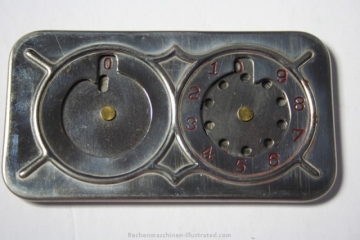
Mindling Vest Pocket Adding Machine (1926)
Manufacturer: G.N.Mindling, Pittsburgh, USA
based on Stephenson's adder
| principle | disk adder |
|
|
| capacity | 2 |
||
| input | stylus | ||
| prod. years | from 1926 | ||
| mach. built | |||
| features | column adder | ||
| dimensions | 8.3 x 4.8 cm | ||
| weight | |||
| known s/n | |||
| price | $1.85 (1926) | ||
| for bigger and more pictures, click on the picture | |||
| source: L.Rupp |
Martin (Dtsch), page 446
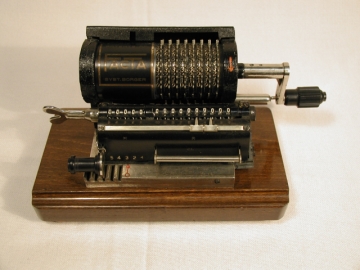
originally introduced 1925 under the name Productor, manufacturer: Productor-Rechenmaschinenwerke, Wien
1927 produced as Facta by Facta-Rechenmaschinenwerk Leo Borger, Wien
| principle | pin wheel |
|
|
| capacity | 8 (w/o cr) x 5 (w/o tc) x 10 |
||
| input | cursor, rotating | ||
| prod. years | 1927 | ||
| mach. built | |||
| features | |||
| dimensions | 17 x 10 x 9 cm | ||
| weight | 1.3 kg | ||
| known s/n | 4.991 | ||
| price | RM 145,- (1927) | ||
| for bigger and more pictures, click on the picture | |||
| source: F.Pehmer |
Martin (Dtsch), page 448
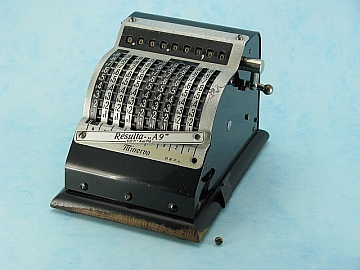
Manufacturer: Paul Brüning, Berlin, Germany
originally introduced under the name Minerva
Literature and links:
Blümich, Wolf-G.: "Kleinaddiermaschinen Resulta" in: Histor.Bürowelt Nr. 69 (2004) (IFHB)
| principle | tooth segment |
|
|
| capacity | 9 (w/o cr) x x 9 |
||
| input | stylus | ||
| prod. years | 1927 - 1943 | ||
| mach. built | |||
| features | 1 species | ||
| dimensions | |||
| weight | |||
| known s/n | |||
| for bigger and more pictures, click on the picture | |||
| source: van Noort |
| principle | tooth segment |
|
|
| capacity | 7 (w/o cr) x x 7 |
||
| input | stylus | ||
| prod. years | 1927 - 1945 | ||
| mach. built | |||
| features | 2 species | ||
| dimensions | |||
| weight | |||
| known s/n | 9.36, 1.39 | ||
| for bigger and more pictures, click on the picture | |||
| source: van Noort |
| principle | tooth segment |
|
|
| capacity | 7 (w cr) x x 7 |
||
| input | stylus | ||
| prod. years | 1936 - 1957 | ||
| mach. built | |||
| features | 2 species | ||
| dimensions | 8.5 x 15 x 11 cm | ||
| weight | 1.5 kg | ||
| known s/n | no s/n, engraved mmyy of production | ||
| for bigger and more pictures, click on the picture | |||
| source: HJ.Denker |
model 7 / E7
| principle | tooth segment |
|
|
| capacity | 7 x x 7 |
||
| input | stylus | ||
| prod. years | 1957 - 1969 | ||
| mach. built | |||
| features |
2 species, input cntrl display blind in result display |
||
| dimensions | 8.5 x 15 x 11 cm | ||
| weight | 1.5 kg | ||
| known s/n | no s/n, engraved mmyy of production | ||
| for bigger and more pictures, click on the picture | |||
| source: H.Schneemann |
| principle | tooth segment |
|
|
| capacity | 7 x x 7 or 9 x x 9 |
||
| input | stylus | ||
| prod. years | 1957 - 1969 | ||
| mach. built | |||
| features |
2 species, as model 7, integrated printer |
||
| dimensions | 16 x 26 x 14 cm | ||
| weight | 4 kg | ||
| known s/n | no s/n, engraved mmyy of production | ||
| for bigger and more pictures, click on the picture | |||
| source: B.Hensel |
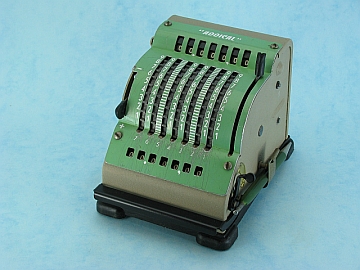
Resulta machines were also distributed in France under the brand "ADDICAL" by ECLAIR-BUREAU
| principle | tooth segment |
|
|
| capacity | 7 (w cr) x x 7 |
||
| input | stylus | ||
| prod. years | |||
| mach. built | |||
| features |
2 species |
||
| dimensions | |||
| weight | |||
| known s/n | 662 | ||
| for bigger and more pictures, click on the picture | |||
| source: van Noort |
8 digit clone of the Resulta BS
manufacturer unknown
distributed between 1946 - 49 in Switzerland by W. Häusler-Zepf in Olten (Schweiz)
| principle | tooth segment |
|
|
| capacity | 8 (w cr) x x 8 |
||
| input | stylus | ||
| prod. years | 1936 - 1957 | ||
| mach. built | |||
| features | 2 species | ||
| dimensions | |||
| weight | |||
| known s/n | 9.085 | ||
| for bigger and more pictures, click on the picture | |||
| source: van Noort |
Martin (Dtsch), page 412
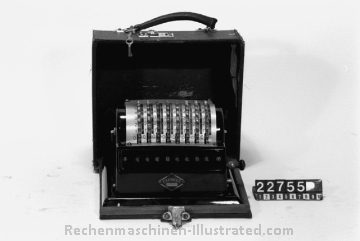
"The Express was a 7 digit adding machine with direct finger input, weight 3.5 kg, automatic tenth carriage, zeroing with butterfly screws. Manufacturer was Otto Rübner, Berlin, however since a couple of years the machine is not produced anymore"
| principle |
|
||
| capacity | 7 or 8 |
||
| input | finger pads | ||
| prod. years | 1928 | ||
| mach. built | |||
| features |
adding machine |
||
| dimensions | |||
| weight | 3.5 kg | ||
| known s/n | |||
| for bigger and more pictures, click on the picture |
source: ©Tekniska museet, Stockholm
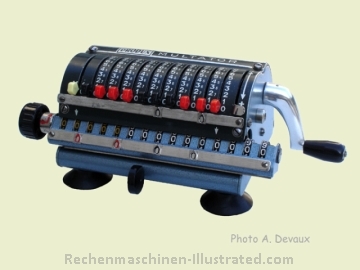
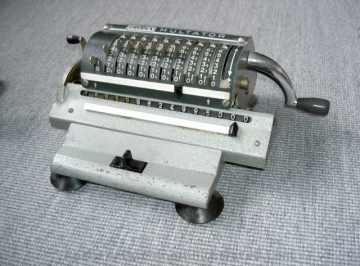
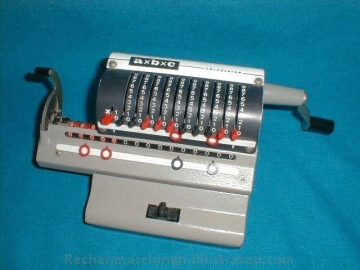
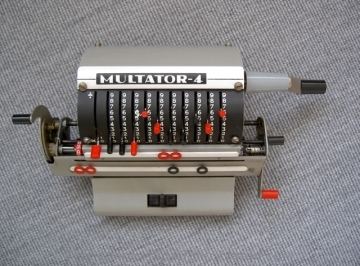
Manufacturer: Meuter & Sohn, Berlin, later Hamburg (D)
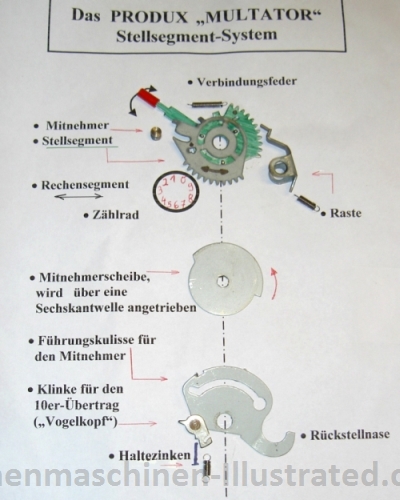
Otto Meuter started 1918 with the invention of an add/subtract slider, which was marketed under the names "Addiator", "Pro Calculo" and "Correntator". In 1928 he founded his own company and sold the add/subtract slider under the name "Produx".
From 1953 a 3 species machine (division was not possible resp. very cumbersome) was manufactured and marketed under the name "Multator" (in France "Multical"), one model had the name "a x b x c".
Literature and links:
Reese, M.: "Die Firma Otto Meuter & Sohn: Rechenapparate und Rechenmaschinen für den kleinen Mann" in: Histor.Bürowelt Nr. 43 (1995), pages 19 - 31 (IFHB)
Reese,M.: Neue Blicke auf alte Maschinen (2002) , pages 112 - 117 (IFHB)
source: M.Reese
| principle | adapting segment |
|
|
| capacity | 10 (w/o cr) x 5 (w/o tc) x 10 |
||
| input | cursors | ||
| prod. years | 1954 | ||
| mach. built | ca. 10.000 | ||
| features |
|
||
| dimensions | 24 x 14 x 8 cm | ||
| weight | |||
| known s/n | ca. 500 - 10.000 | ||
| for bigger and more pictures, click on the picture |
source: A.Devaux
| principle | adapting segment |
|
|
| capacity | 10 (w cr) x 5 (w/o tc) x 10 |
||
| input | cursors | ||
| prod. years | 1955 - 1966 | ||
| mach. built | |||
| features |
division by use of complement numbers, back transfer |
||
| dimensions | 26 x 17 x 9 cm | ||
| weight | 2 kg | ||
| known s/n | ca.10 000 - 46 000 | ||
| for bigger and more pictures, click on the picture |
source: M.Reese
| principle | adapting segment |
|
|
| capacity | 10 (w/o cr) x 5 (w/o tc) x 10 |
||
| input | cursors | ||
| prod. years | 1962 - 1970 | ||
| mach. built | |||
| features |
3 species, back transfer |
||
| dimensions | 26 x 17 x 9 cm | ||
| weight | 2 kg | ||
| known s/n | ca. 25.000 - (3) 68.000 | ||
| for bigger and more pictures, click on the picture |
source: HJ.Denker
| principle | adapting segment |
|
|
| capacity | 10 (w/o cr) x 5 (w/o tc) x 10 |
||
| input | cursors | ||
| prod. years | 1963 - 1969 | ||
| mach. built | |||
| features | true division |
||
| dimensions | 26 x 17 x 9 cm | ||
| weight | 2 kg | ||
| known s/n | ca. 40.000 - (4) 63.000 | ||
| for bigger and more pictures, click on the picture |
source: M.Reese
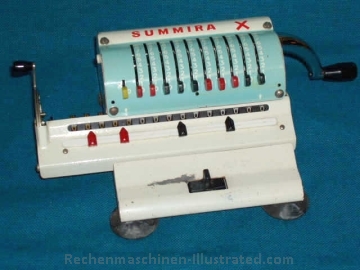
manufacturer: O.Meuter & Sohn
distribution: Summira KG, Roisdorf/Bonn (Summira)
| principle | adapting segment |
|
|
| capacity | 10 x 5 x 10 | ||
| input | cursors, non-rotating | ||
| production years | around 1955 | ||
| machines built | |||
| features | 3 species | ||
| known s/n | 33.685 | ||
| for bigger and more pictures, click on the picture |
source: HJ.Denker
Manufacturer: Reliable Typewriter and Adding Machines Co., Chicago (US)
| principle | disk adder |
|
|
| capacity | 8 x x 8 |
||
| input | stylus | ||
| prod. years | 1928 - 1950 | ||
| mach. built | |||
| features | also for brit.currency and fractions |
||
| dimensions | 30 x 6 x 1.5 cm | ||
| weight | 0.5 kg | ||
| known s/n | |||
| for bigger and more pictures, click on the picture | |||
| source: H.Schneemann |
Manufacturer: Otto Hübner, Rechenmaschinen- und Apparate-Bau, Berlin-Wilmersdorf (D)
| principle | tooth disks |
|
|
| capacity | 8 x x 8 |
||
| input | finger pads | ||
| prod. years | 1928 | ||
| mach. built | |||
| features |
|
||
| dimensions | 20 x 18 x 14 cm | ||
| weight | |||
| known s/n | 7.529 | ||
| for bigger and more pictures, click on the picture | |||
| permission granted |
Martin (Dtsch), page 414
"Construction: Clyde Gardner, manufacturer: Gardner Calculator Co, Ebensburg, Pa. Since 1931 distribution of the machine thru the Monroe Company, since then the machines carry almost exclusively the name Monroe."
| principle | tooth rack |
|
|
| capacity | 9 x x 10 |
||
| input | full keyboard | ||
| prod. years | 1928 | ||
| mach. built | |||
| features | printer |
||
| dimensions | |||
| weight | |||
| known s/n | |||
| for bigger and more pictures, click on the picture | |||
| source: G.Emiliani |
Martin (Dtsch), page 424
In 1929 the Hannovera company was in financial trouble. The Swiss company "EOS-Genossenschaft für Fabrikation und Vertrieb von Rechenmaschinen" bought parts and partly or complete assembled Hannovera CK and sold them under the name EOS.
 (2MB) M.Reese: Hannovera
und EOS from "Neue
Blicke auf alte Maschinen" (in German)
(2MB) M.Reese: Hannovera
und EOS from "Neue
Blicke auf alte Maschinen" (in German)
(permission from the author)
| principle | adapting segment |
|
|
| capacity | 9 x 8 x 13 | ||
| production years | 1929 | ||
| machines built | ca. 800 | ||
| features | no tenth carriage in counter register | ||
| s/n | 20.001 - ca. 20.800 | ||
| for bigger and more pictures, click on the picture |
source: A.Pohl
Martin (Dtsch), pages 447 - 448
| principle | pin wheel |
|
|
| capacity | 10 x 8 x 13, 10 x 8 x 16 |
||
| input | cursors, rotating | ||
| prod. years | 1950 - 1954 | ||
| mach. built | |||
| features |
identical to Walther WR16 |
||
| dimensions | |||
| weight | |||
| known s/n | 20.019 | ||
| for bigger and more pictures, click on the picture | |||
| source: F.Haeghens |
| principle | pin wheel |
|
|
| capacity | 10 x 8 x 16 | ||
| input | cursors, non-rotating | ||
| production years | 1952 - 1957 | ||
| machines built | |||
| features | identical to Walther WSR 16 | ||
| back transfer | |||
| known s/n | 21.433, 22.314 | ||
| for bigger and more pictures, click on the picture | |||
| source: HJ.Denker |
| principle | adding segments |
|
|
| capacity | 10 x x 10 |
||
| input | 10 keyboard | ||
| prod. years | 1958 - 1960 | ||
| mach. built | |||
| features |
electric, printing, autom. division, semi-autom. multipli- cation |
||
| dimensions | 24 x 45 x 21 cm | ||
| weight | 13 kg | ||
| known s/n | N 1.441.813 | ||
| price | DM 1.590,- (1959) | ||
| for bigger and more pictures, click on the picture | |||
| source: E.Anthes |
(Brennan, Monarch, Torpedo)
"The today known as Remington Portable writing 10-key adding machine was issued to the market 1929 under the name Brennan by the Brennan Adding Machine Co., 122, South Michigan Avenue, Chicago. In 1932 the production rights were turned over to the Remington Typewriter Co."
| principle | adding machine |
|
|
| capacity | 9 | ||
| input | 10 keyboard | ||
| production years | 1929 - 1932 | ||
| machines built | |||
| features | |||
| known s/n | |||
| for bigger and more pictures, click on the picture | |||
| source: Clyde M. Desouches |
Martin (Dtsch), page 454
"Small adding machine in the form of the known machines with catch tenth carriage, but with automatic tenth carriage up to the last digit. Manufacturer: Albert Steinmann, La-Chaux-De-Fonds, Suisse."
| principle | chain adder |
|
|
| capacity | various | ||
| input | stylus | ||
| production years | 1930 - ??? | ||
| machines built | |||
| features | |||
| known s/n | |||
| for bigger and more pictures, click on the picture | |||
| source: J.Goldman |
| principle |
|
||
| capacity | 9 (w cr) x 9 x 18 |
||
| input | full keyboard | ||
| prod. years | 1938 - 1948 | ||
| mach. built | |||
| features |
|
||
| dimensions | |||
| weight | |||
| known s/n | 51.857 | ||
| for bigger and more pictures, click on the picture | |||
| permission granted |
| principle | tooth rack |
|
|
| capacity | 9 x x 9 |
||
| input | stylus | ||
| prod. years | ca. 1945 - 1955 | ||
| mach. built | |||
| features |
|
||
| dimensions | 15 x 20 x 13 cm | ||
| weight | 2 kg | ||
| known s/n | 14.362 | ||
| for bigger and more pictures, click on the picture | |||
| source: E.Anthes |
Manufacturer: N.K.T.P., UdSSR
Volks-Kommissariat Schwer-Produktion, Fabrik Nr. 2, UdSSR
| principle | pinwheel |
|
|
| capacity | 9 x 8 x 13 | ||
| input | cursors, rotating | ||
| production years | from 1930 | ||
| machines built | |||
| features | |||
| known s/n | 6.334 | ||
| for bigger and more pictures, click on the picture | |||
| source: HJ.Denker |
not well known machine from Sweden, similar to Addac. Sales by AB Affärsystem.
| principle | tooth disks |
|
|
| capacity | 7 (w/o cr) x x 7 |
||
| input | finger pads | ||
| prod. years | ca. 1930 | ||
| mach. built | |||
| features | 2 species machine, subtraction by complementary digits |
||
| dimensions | 20 x 13 x 13 | ||
| weight | |||
| known s/n | 47.427, 471.023 | ||
| for bigger and more pictures, click on the picture | |||
| source: R.Rehbein |
manufacturer: Bair-Fulton Company, York - Pennsylvania (US)
| principle | tooth gear |
|
|
| capacity | 6 or 8 |
||
| input | stylus | ||
| prod. years | ca. 1930 | ||
| mach. built | |||
| features | no tenth carriage |
||
| dimensions | |||
| weight | |||
| known s/n | |||
| for bigger and more pictures, click on the picture | |||
| source: Thomas A. Russo |
| principle | tooth gear |
|
|
| capacity | 11 |
||
| input | stylus | ||
| prod. years | ca. 1930 | ||
| mach. built | |||
| features | no tenth carriage |
||
| dimensions | |||
| weight | |||
| known s/n | |||
| for bigger and more pictures, click on the picture | |||
| source: Thomas A. Russo |
Martin (Dtsch), page 431
manufacturer: Mauser-Werke AG, Oberndorf (Neckar), D
literature: E.Anthes: Dr. Ing. Helmut Gelling - Konstrukteur von Rechenmaschinen, in: Historische Bürowelt 41 (1995), S. 21 - 28
| principle | adding segments |
|
|
| capacity | 10 x x 11 |
||
| input | 10 keyboard | ||
| prod. years | starting 1931 | ||
| mach. built | |||
| features | 2 species machine, electric |
||
| dimensions | 24 x 49 x 28 cm | ||
| weight | 16 kg | ||
| known s/n | 10.177, 11.839, 17.012 | ||
| for bigger and more pictures, click on the picture | |||
| source: K.Schildbach |
Martin (Dtsch), page 445
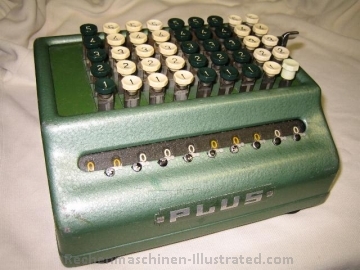
Pettometer, Plus-Minor
"The today's Plus was called originally Pettometer and was manufactured by Petters Ltd. . The manufacturing rights were transferred later to the Bell Punch CO, Ltd., a 1878 created company, which manufactures the machine in its factory in Uxbridge. The smaller model is called Plus-Minor."
all adding machines from Bell Punch with half keyboard were marketed under the name "Plus"
literature:
Nigel Tout: The Bell Punch Company
| principle | adding machine |
|
|
| capacity | 5 or 9 | ||
| input | half keyboard | ||
| production years | |||
| machines built | |||
| features | also models for British currency | ||
| known s/n | |||
| for bigger and more pictures, click on the picture | |||
| source: B.Franke |
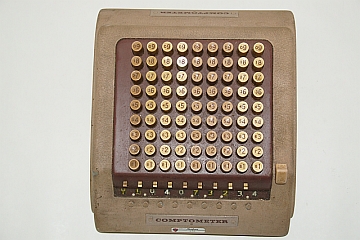
Sumlock is the trade name for all Bell Punch adding machine with full keyboard.
they are from the type of the Felt & Tarrant Comptometers.
"In mid-1960 Control Systems Ltd. (the parent of Bell Punch) acquired the English operation of Comptometer Corporation (previously the Felt & Tarrant Manufacturing Company) of Chicago, U.S.A., including the trademark and the right to the "Comptometer" name in England, and then signed a contract with Control Systems to have all their machines manufactured in England. Sumlock machines then appeared under the Comptometer label." (Nigel Tout)
| principle | adding machine |
|
|
| capacity | 9 x x 10 | ||
| input | full keyboard | ||
| production years | |||
| machines built | |||
| features | also models for British currency | ||
| known s/n | 950.371 | ||
| for bigger and more pictures, click on the picture | |||
| source: Pricebook Auction |
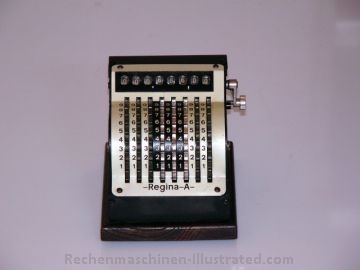
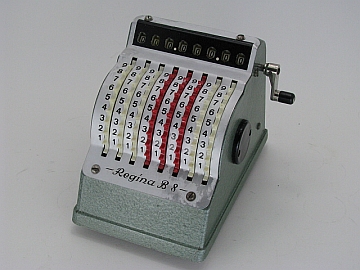
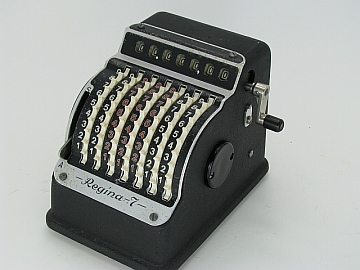
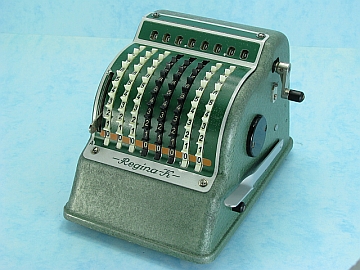
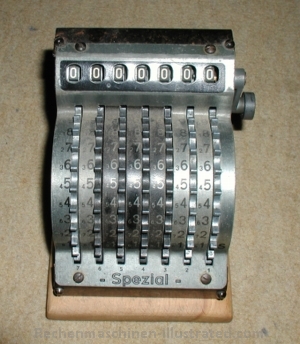
manufacturer: Hinrich Holz, Oberbilstein im Bergischen Land
Regina machines were also marketed under the brand Spezial
| principle | tooth disks |
|
|
| capacity | 8 (w/o cr) x x 8 |
||
| input | finger pads | ||
| prod. years | since 1932 | ||
| mach. built | |||
| features |
adding machine |
||
| dimensions | 17 x 19 x 16 cm | ||
| weight | 2.5 kg | ||
| known s/n | |||
| for bigger and more pictures, click on the picture | |||
| source: A.Jeanroy |
| principle | tooth disks |
|
|
| capacity | 8 (w/o cr) x x 8 |
||
| input | finger pads | ||
| prod. years | since 1956 | ||
| mach. built | |||
| features |
adding machine |
||
| dimensions | 16 x 18 x 14 cm | ||
| weight | 1.1 kg | ||
| known s/n | |||
| for bigger and more pictures, click on the picture | |||
| source: van Noort |
| principle | tooth disks |
|
|
| capacity | 7 (w/o cr) x x 7 |
||
| input | finger pads | ||
| prod. years | |||
| mach. built | |||
| features |
2 species |
||
| dimensions | |||
| weight | |||
| known s/n | |||
| for bigger and more pictures, click on the picture | |||
| source: van Noort |
| principle | tooth disks |
|
|
| capacity | 8 (w/o cr) x x 8 |
||
| input | finger pads | ||
| prod. years | 1955 - 1958 (?) | ||
| mach. built | |||
| features |
2 species |
||
| dimensions | 18 x 22 x 15 cm | ||
| weight | 2.1 kg | ||
| known s/n | |||
| for bigger and more pictures, click on the picture | |||
| source: van Noort |
| principle | tooth disks |
|
|
| capacity | 7 (w/o) x x 7 |
||
| input | finger pads | ||
| prod. years | from 1932 | ||
| mach. built | |||
| features | 1 species, subtraction by use of complement numbers | ||
| dimensions | 13 x 15 x 13 cm | ||
| weight | 2 kg | ||
| known s/n | |||
| for bigger and more pictures, click on the picture | |||
| source: R.Chirico |

last updated: 21-Feb-12